September 14, 2026
Author:
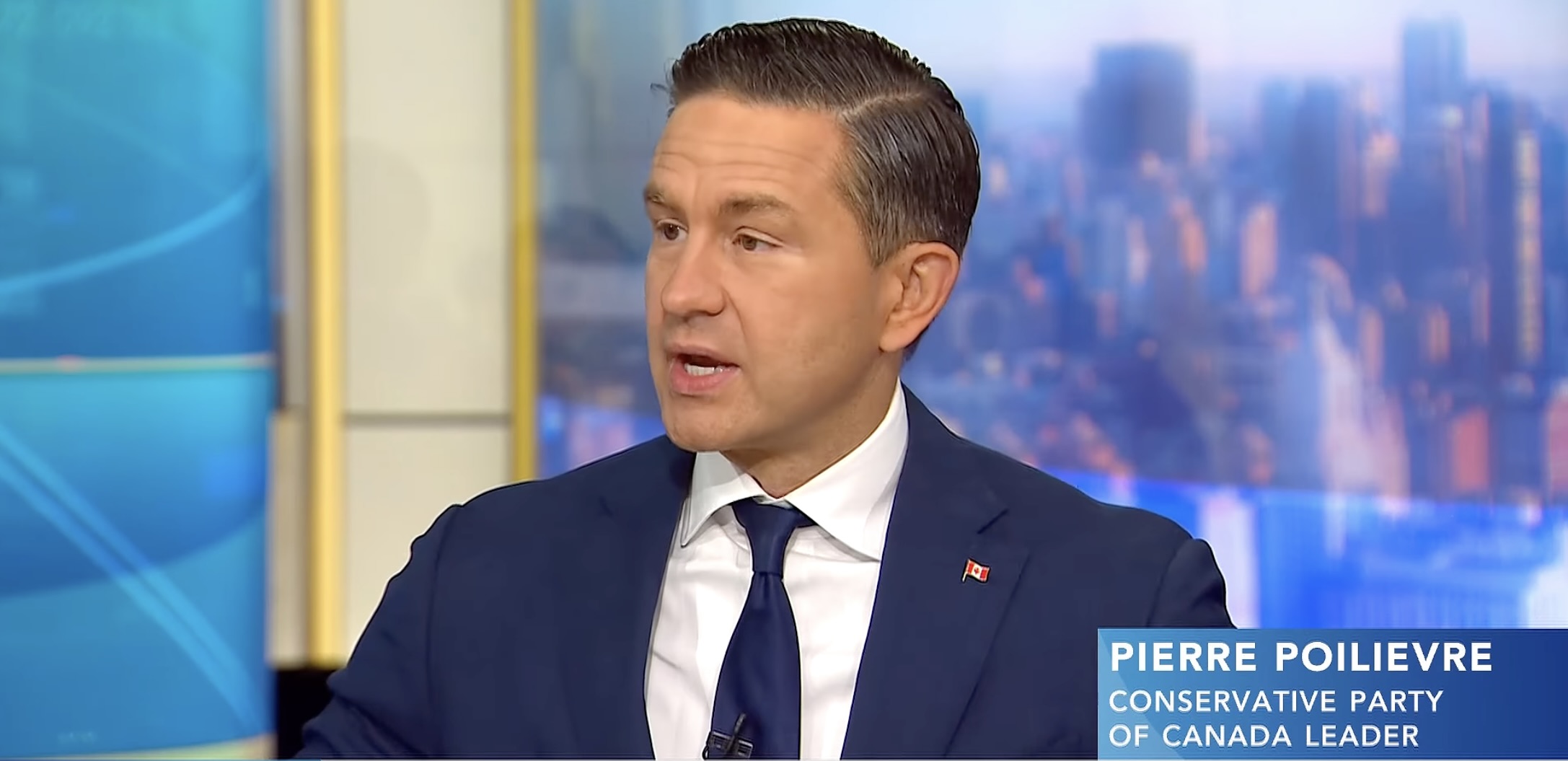
Pierre Poilievre’s recent visit to New York came at a difficult moment in the Canada–U.S. relationship. Tariffs are disrupting continental trade, economic nationalism is reshaping American policy, and Canadians are confronting uncomfortable questions about a partnership we have long regarded as permanent.
Through interviews with CNBC, Bloomberg and Fox Business, Poilievre took Canada’s case directly to American audiences. His immediate argument was for tariff-free trade, but the larger message was strategic: Canada and the United States will be stronger if we combine our economic, energy and security advantages rather than erect barriers between them.
There was also significance in the decision to go. At a moment when Canadian voices need to be heard directly in the United States, it took political courage for the Leader of the Opposition to enter the American public debate and make Canada’s case. It would have been easier to criticize Washington from Ottawa; instead, Poilievre spoke directly to American business and financial audiences about why a deteriorating relationship ultimately serves neither country.
Canada needs leaders willing to engage Americans directly, particularly when the conversation is difficult. Engagement does not mean acquiescence, just as friendship does not require silence when our interests diverge. Effective diplomacy requires the confidence to enter the room, articulate the Canadian interest and demonstrate why cooperation remains beneficial to both countries.
Poilievre’s visit also coincided with the 25th anniversary of the September 11 terrorist attacks, providing an important reminder of how Canadians and Americans stood together in the aftermath. The world has changed dramatically since 2001, but one fundamental reality has not: the security and prosperity of our two countries remain deeply interconnected.
Today, economic security and national security are increasingly inseparable. Energy, critical minerals, artificial intelligence, semiconductors, telecommunications, space and advanced manufacturing have become instruments of national power. Russia’s war against Ukraine has exposed the consequences of inadequate defence capacity, China’s rise has transformed how governments think about supply chains and strategic dependence, and a more accessible and contested Arctic has placed renewed importance on Canada’s geography.
Canada cannot assume that relationships and institutions built during the last century will automatically protect our interests in this one.
One of the more effective aspects of Poilievre’s visit was his decision to frame Canada’s case around mutual interests rather than Canadian grievances. His argument was not simply that tariffs hurt Canadian workers and businesses, but that weakening Canada economically can impose costs on Americans as well.
Canada has a great deal to offer: abundant energy and critical minerals, sophisticated aerospace, defence, space and technology industries, highly capable military personnel, longstanding intelligence relationships and geography central to the defence of North America.
Our challenge is converting those advantages into influence.
Canada should approach Washington with a clear proposition: our resources can strengthen North American energy and supply-chain security, our industries can contribute to allied defence production, and our geography makes us indispensable to continental defence.
That is a stronger foundation for the relationship than asking for preferential treatment simply because we have historically been friends.
My perspective on this relationship comes partly from having seen it from inside government.
My interest in national security began through my education and became practical experience when I served as Political Special Assistant for National Security to the Honourable Stockwell Day during his tenure as Minister of Public Safety.
I worked on national security, emergency management, cybersecurity, intelligence cooperation, border management and law enforcement, and had the opportunity to travel to Washington for engagements at the White House and with American national-security agencies.
What I remember particularly clearly was the access Canada enjoyed. Under Prime Minister Stephen Harper’s leadership, Canadian officials and political representatives entered many of those conversations confident that Canada was regarded as a serious economic and security partner. Doors were open, relationships were active and, although our countries inevitably disagreed on particular issues, Canada had an important place at the table.
Over the years, I have watched that dynamic change. The United States itself has changed considerably, and no Canadian government controls the political environment in Washington, but Canada’s access and influence have also appeared more constrained as the relationship has become increasingly transactional.
That should cause us to examine not only what has changed in Washington, but what has changed in Canada.
Access is partly a measure of relevance. When important doors become harder to open, we should ask whether Canada has done enough to maintain the strategic value and influence we once took for granted.
My work subsequently extended into the Department of International Trade at Global Affairs Canada during the aftermath of the global financial crisis and the restructuring of the North American automotive sector. That experience reinforced how deeply integrated our economies had become, with production lines, suppliers, workers and capital crossing the border to such an extent that treating the Canadian and American economies as entirely separate systems often made little sense.
That principle applies equally to Canadian sovereignty, which means more than borders and constitutional authority. Genuine sovereignty requires the capacity to monitor and defend our territory, protect critical infrastructure, secure our borders and maintain the economic and industrial resilience necessary to withstand disruption.
Canada therefore needs to modernize the Canadian Armed Forces, strengthen Arctic infrastructure and surveillance, rebuild our defence-industrial capacity, responsibly develop our natural resources and treat critical technologies as strategic national assets.
A stronger Canada will have greater influence with the United States while possessing greater freedom to disagree when our interests diverge. Our objective should be neither dependence upon Washington nor distance from it, but a mature partnership between two sovereign countries whose security and prosperity will remain deeply interconnected.
The current tariff dispute will eventually change, as political disputes always do, but geography will not. Presidents and prime ministers will come and go, while Canada will continue sharing a continent and deeply integrated economy with the United States and facing three oceans, a contested Arctic and an increasingly unstable world.
The question is therefore not whether Canada should engage Washington, because geography settled that long ago. The question is what Canada brings to the table when we do.
That question has followed me throughout my career, from studying national security and working on Canada–U.S. security cooperation, through international trade and the automotive crisis, and subsequently through my work in business, defence, industry and international affairs.
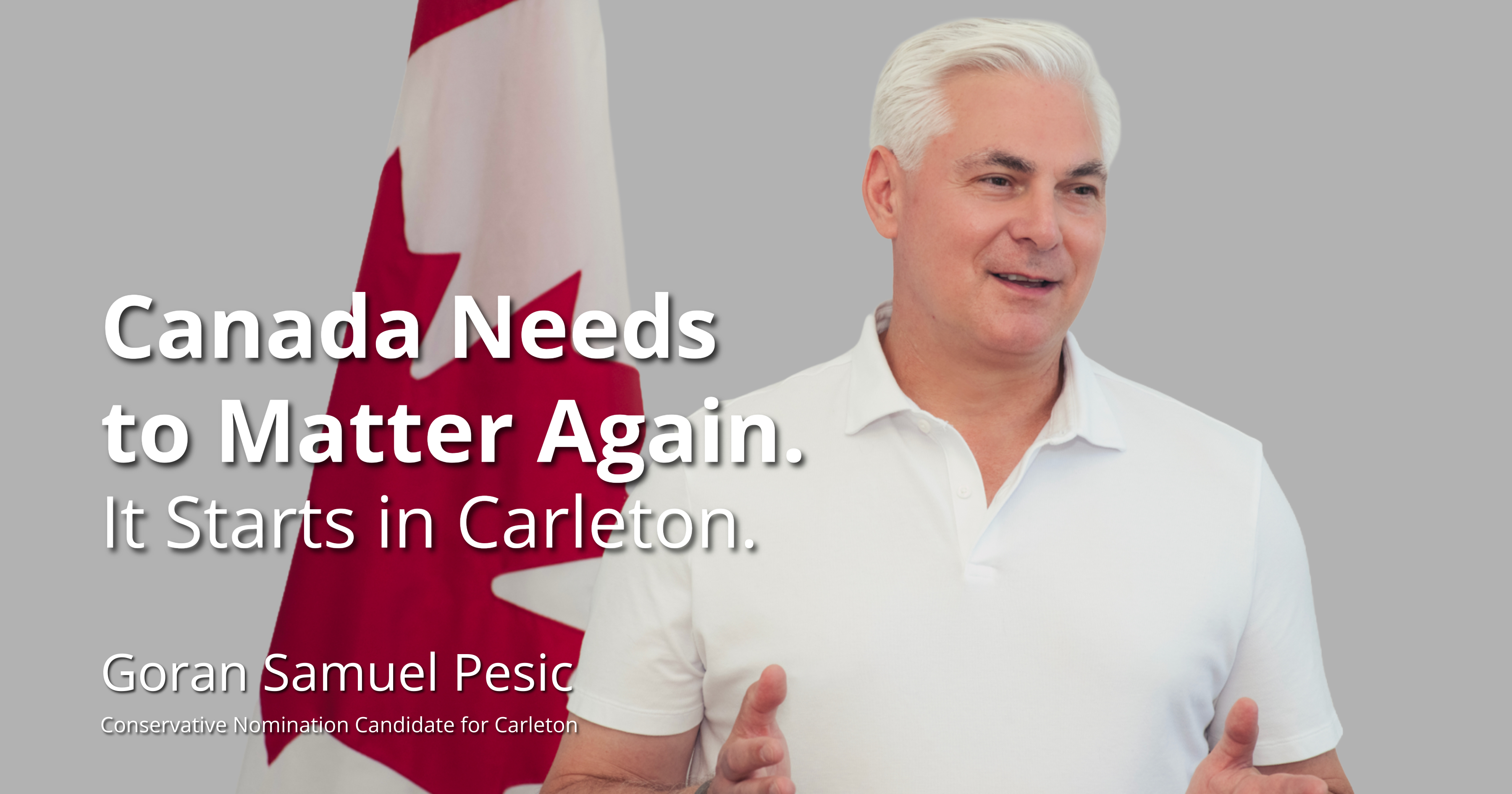
It has also helped shape my decision to seek the Conservative nomination in Carleton.
For much of my professional life, I have worked around government and with the institutions, industries and people affected by the decisions governments make. I have seen government from the inside, worked with businesses seeking to grow and create jobs, engaged with Canada’s allies and spent much of my career working within our defence and national-security community.
There comes a point when experience should not simply inform public policy from outside government, but should be offered directly in public service. I have reached that point in my own life.
My family and I live in Carleton, our children attend the local high school in Manotick, and this is the community where we have built our life. I want to serve it, but I am also stepping forward because I believe Canada is approaching a consequential political moment.
Conservatives have an opportunity to form the next government, and I want Carleton to be part of that success. A government taking office in the environment Canada now faces will need people who understand not only their communities, but also government, business, national security and the international relationships upon which Canadian prosperity increasingly depends.
That is the experience I am offering.
Local experience matters because an MP must understand the communities they represent. National experience matters because governing requires an understanding of institutions, public policy and the economy. International experience increasingly matters because decisions made in Washington, NATO capitals and across the Indo-Pacific directly affect Canadian jobs, security and prosperity.
For me, seeking public office is therefore not simply another stage in a career. It is a decision to put the experience I have accumulated in government, business, national security, defence and international affairs directly to work for the community my family calls home and for the country I have spent much of my professional life serving.
No candidate can do that alone, and no serious political campaign is built around one person. It is built by people across a community who are prepared to become involved, bring others with them and contribute their time and energy to something they believe matters.
That is why I am asking Conservatives and like-minded residents from across Carleton to join our growing team. We need volunteers willing to speak with neighbours, recruit new Conservative members, attend community events, knock on doors, make calls and help us build an organization that reaches every part of this large and diverse riding.
You do not need years of political experience to participate. A strong campaign should reflect the community it seeks to represent, including families, farmers, entrepreneurs, small-business owners, young people, seniors, veterans, newcomers and residents becoming politically involved for the first time.
Growing our membership and volunteer organization now will give us the grassroots foundation we need for the challenges ahead. More importantly, it will ensure that this campaign is built not around one individual, but around people from throughout Carleton who share a belief that our community and our country can do better.
Canada enters this period with advantages many countries would envy. We are a G7 economy with enormous natural resources, sophisticated industries, an educated population and privileged access to the world’s largest economy, while our Atlantic, Pacific and Arctic geography places us at the centre of some of the defining economic and security questions of the coming decades.
Pierre Poilievre’s American visit mattered because he was prepared to present Canada not simply as a neighbour asking for accommodation, but as a sovereign partner with something important to contribute.
That is the Canada I want us to become again: capable, confident and consequential.
Canadian voices need to be present in Washington when relations are difficult because we cannot influence conversations in which we are absent. The same principle applies here at home, where those who believe our country needs a different direction must also be prepared to participate in bringing that change about.
Canada should be neither a supplicant nor an adversary in Washington, but a capable, confident and reliable ally that understands its interests, articulates them clearly and possesses the strength to defend them. The stronger we become at home, the more influence we will have abroad and the greater our ability will be to determine our own future.
Building that Canada will require strong leadership and a government prepared to act, but it will also require experienced people who understand their communities, their country and the increasingly complex world beyond our borders.
That is why I am putting my name forward in Carleton, and why I am inviting people from every part of the riding to join me. If we can build a broad grassroots organization, grow our membership and bring together people who want a stronger community and a more consequential Canada, we can turn those convictions into something larger than any one campaign.
Conservative Nomination Candidate for Carleton